Okay, I guess I need to pick up the pace on my blogging so I'll try to give less history so I can keep this thing moving. = )
To get to the Vatican Museum, you have to exit Vatican City, walk around the wall surrounding the city and then to the door of the Vatican Museum that is right in the city wall.
 |
| Door to the Vatican Museum |
I had pre-bought tickets to a special night time event at the museum. They had the exhibits open till 11 pm and there was a concert going on somewhere in the museum. (The museum is huge - we never made it to the part where the concert was going on.) The museum was founded in 1506 by Julius II and has been added to over the centuries. It is quite the collection and includes some of the greatest classical sculptures and Renaissance art. Modern art is also housed here.
 |
| Ancient Egyptian Lion |
 |
| Old building with modern sculpture |
We passed through a building with lots of Roman statues and busts. We saw the sarcophagus of the guy who was defeated by Hannibal but whose grandson drove Hannibal back out of Italy.
 |
| Roman statues and busts |
 |
| Roman sarcophagus |
We saw rooms with amazing paintings on the ceiling. The walls were also painted during the Renaissance.
 |
Taran found a chair.
Gorgeous old paintings on the wall! |
Then we entered the a courtyard with more sculptures, sarcophagi, columns, and even giant bath tubs.
 |
| Can't remember who this is. = ( |
 |
| Sarcophagus with beautiful relief |
 |
| Andrew is enthralled by the giant bath - once stood in the baths of Caracalla |
 |
| Carved column |
 |
| Statue of Apollo - he used to hold a bow in his right hand |
 |
| Piper and Artemis |
 |
| A river god |
 |
| Carved portrait of a married couple placed at their tomb |
One of the most famous sculptures in the courtyard and the one that started the whole museum is the statue of Laocoon and his sons. It was found in a vineyard near Rome in 1506, purchased by the pope, and put on display a month later. And the collection has grown ever since. Laocoon was the man in the story of the Trojan Horse that suspected that the horse was a ruse of the Greeks and tried to thrust a spear into it to prove this to the Trojan officials. But Zeus sent serpents to attack Laocoon and his sons because Zeus was on the side of the Greeks. The Trojans, however, thought this was a sign that the horse was sacred so they brought it into the city and you know the rest of the story.
 |
| Poor guy . . . = ( |
There were so many things to see just in that courtyard!
 |
| Piper found a cute, giant dog. |
 |
| This one, however, is a bit scary. |
 |
| A relief of a married couple at the gates of Underworld talking to Persephone and Hades |
 |
| What Taran looks like when Piper eats all the chocolate. |
 |
| Piper's face when she sees a piano. |
 |
| Greeks battling the Amazons |
 |
| Andrew translated: Diane's sacred cat, Felix |
 |
| Venus and Cupid |
 |
| That's a big toe! |
 |
| Piper does her best Roman sculpture pose. |
We passed quickly through the Sala degli Animali - the hall of animals. It contained, not surprisingly, statues of animals.
After that was the Sala delle Muse with statues of the muses and some busts of ancient poets and authors.
 |
| Sophocles |
 |
| Homer |
 |
| Euripides |
 |
| Euterpe - muse of music |
 |
| Calliope - muse of poetry |
 |
| Thalia - muse of comedy |
The ceiling was amazing too.
 |
| Ceiling in Muse room |
Though now that I look at it doesn't tell a very nice story. It looks like the boy is pleading with the lady not to kill the man. The lady doesn't look like she's persuaded to let him off. Probably another bloody Roman god story.
Also in this room was the Belvedere Torso. That is really all it is - no head, arms or legs. But it was greatly admired by Michelangelo and he used it as inspiration for many of his works. It is unknown who the figure was supposed to be but many think it was Hercules. I am sure that the piece is amazing for its detail but I don't think I appreciate it as much as Michelangelo did.
 |
| Belvedere torso |
If you think that one is missing a lot of body parts, look at this next one - only toes. = )
Next was a room with a mosaic covering the whole floor and a bath tub that made the ones outside look tiny.
 |
| The bronze guy is Hercules. |
Next was the Greek Cross Gallery. Here was the sarcophagi of Constantina (daughter of Constantine the Great - first Christian Roman emperor) and St. Helena (mother of Constantine the Great). She was a Christian before Constantine became one.
 |
| Sarcophagus of St. Helena |
Some experts think that this sarcophagus was originally meant for Constantine himself because the relief carved in it shows battle scenes - manly type stuff.
Next we visited the rooms with the ancient Egyptian artifacts. I am still so fascinated by all the tablets decorated with hieroglyphics and Egyptian figures.
 |
| Queen Hatshepsut |
 |
| So cool! |
The top picture is a rare carving depicting the only major female pharaoh - Queen Hatshepsut. (Cleopatra doesn't count - she wasn't Egyptian.) Most of her statues and such were torn down after she died to wipe her from history. This tablet is supposed to be from before she took on the title of pharaoh and therefore was not destroyed. There were also other Egyptian stuff including mummies, canopic jars, and some statues.
 |
| Canopic jars - for mummies various organs |
 |
| A mummy! |
 |
| Statue of Osiris, Egyptian god |
 |
| Statue of Anubis in a toga |
The sun was setting and the view of the courtyard with the strange sphere sculpture was really pretty.
 |
| Courtyard at Vatican Museum |
As we continued along we passed more fabulous statues and painted ceilings.
One hall was filled with giant tapestries showing the life of Christ and other stories.
 |
| Baby Jesus |
There was the Hall of Maps with giant maps of different parts of Italy painted on the walls. It was done by friar Ignazio Danti from 1572 to 1585. It is the largest pictorial geographic study in the world.
 |
| One of the last maps showing all of Italy |
We also visited the Raphael Rooms - painted, of course, by Raphael.
 |
| The Disputation of the Holy Sacrament - painted 1508 |

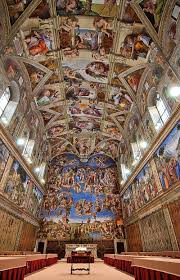
The highlight of the visit, though was definitely the Sistine Chapel. This is the personal chapel of the pope and where new popes get elected. It was the ceiling that we were interested in, though. Of course, that is where we were not allowed to take pictures - grrr. When we first walked into the chapel, I was a bit overwhelmed. There was a lot going on in there.
 |
| Sistine Chapel |
But we had downloaded an audio guide onto my phone and Taran's ipod so we were able to focus on details that would otherwise have been lost to us. It made the whole thing more enjoyable. Pope Julius II (same one that bought the Laocoon statue) asked Michelangelo to do this project in 1508. At first Michelangelo declined - he thought of himself as a sculptor, not a painter. But the pope wouldn't take no for an answer so finally Michelangelo said yes, as long as he could do it his way. The pope had just asked for the twelve apostles along the side of the ceiling but Michelangelo had bigger plans - the history of the world until Jesus. For four years Michelangelo stood on scaffolding that he designed six stories high, craning his neck painting these scenes. He did most of the painting himself (most masters of the age only designed the painting, letting assistants do the actual work). It is 5,900 feet of frescoes. Frescoes are painted on wet plaster. When the plaster dries, it locks in the colors giving them a translucent glow. But you have to finish before the plaster dries. Michelangelo would do about a fourth of a panel in a day. If he didn't get it right the first time, his assistants would have to scrape off the plaster and Michelangelo would start all over. A lot of work but the results are amazing. The bright colors are almost as dazzling as they were when Michelangelo painted them. The ceiling use to be dim and dark because of centuries of soot and dirt. But then it was cleaned in the 1980's revealing shockingly vivid colors.
The ceiling is divided into three parts - the central spine with nine scenes from the Bible (Creation to Noah), prophets on thrones on either side of that, then, in the triangles, figures from the Bible and legends that foretold the coming of Christ. In the very middle of the ceiling is the famous painting of the creation of man.
 |
| Creation of Man |
God is shown powerful and full of energy while Adam is passive and limp. This is a model of the Renaissance spirit. God is not some terrifying giant reaching down to pathetic, useless man. They are on an equal plane. They exchange eye contact - God and man are working together in the process of creation.
The story actually starts 3 panels down with God creating the world.
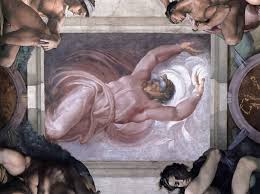 |
| God separated light and dark |
The next panel shows God creating the sun and moon then God separating the land from the water.
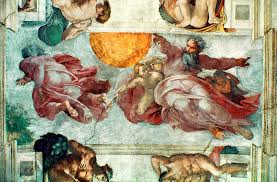 |
| God creates sun and moon |
 |
| God separates land from water |
Painting God like this - as if he were flying directly down on us, is very difficult to draw. Michelangelo was amazing. = ) Then came the creation panel that I already showed you and following that came the creation of Eve, diving out of Adam's side.
 |
| Creation of Eve |
The next panel shows the turning point in the creation story. On the left is Adam and Eve lounging around the Garden of Eden. The serpent (who looks like a woman with snake legs) enters the picture in the middle of the painting, winding around the Tree of Knowledge. At the right, Adam and Eve are sent out of the garden by an angel with a sword.

Then Michelangelo skips to Noah. Here Noah is shown as the only righteous man in a world full of sinners. He is preparing to make a sacrifice to God.
 |
| Sacrifice of Noah |
The next panel is the Flood. The ark is in the top left of the picture. The rest of mankind looks worried.
 |
| The Flood |
Notice the blank spot in the upper right side? In 1793 a nearby gunpowder depot exploded shaking the building and making some of the plaster fall.
The last panel shows drunken Noah being discovered by his sons. Why did Michelangelo decide to end with scene? Perhaps to show that even the best of men aren't perfect. . .
 |
| Drunk Noah discovered by sons |
The pictures of Noah - his sacrifice, flood, etc are much smaller than the pictures at the other end of the ceiling - the ones of God creating the world. Michelangelo started in 1508 at the far end with the Noah scenes and in 1510 he was half way through with the ceiling. He took down the scaffolding to move it over to the other side. It was the first time he was able to see from the floor what he'd been working on for two years. Everyone was wowed! But not Michelangelo. His powerful figures didn't look nearly so powerful so far away. So he changed his tactic for the other half making it less cluttered and more intense.
Flanking the central scenes are the prophets. You can clearly see the different personalities of the different prophets. Here are a few:
Between the prophets are triangles depicting other scenes from the Bible and Christian legends though most of the meaning is unknown to modern visitors. Despite that, the paintings are fascinating just for themselves. Michelangelo was a master of dramatic poses.

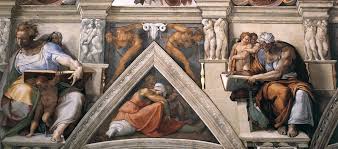
It is hard to find pictures of these triangles but there are a couple. The above picture is from before the ceiling was cleaned. Amazing difference, aye?
In 1512 the ceiling was completed. It has become in many people's opinion the greatest work of art by any one human being. I would have to agree. I could have spent another couple hours just staring at the ceiling.
Twenty-three years later, another pope asked Michelangelo to come back to the Sistine Chapel and cover the wall behind the altar with a painting of the Last Judgement. The Michelangelo that painted the Last Judgement was a very different man from the one that painted the ceiling - he had lost much of his optimism and belief in the goodness of man. The Creation of Man was all about the positive outlook of the Renaissance but that isn't present here in the Last Judgement. God is shown as wrathful and scary and man cowers before him.
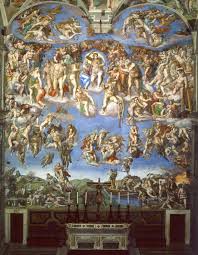
Christ is in the center raising his arm to smite the wicked. Beneath him angels sound the trumpets calling the sleeping dead. The dead, in the lower left corner, rise from their graves to be judged. The righteous, on the upper left, are raised up to heaven while the wicked on the other side are thrown down to hell. The Greek underworld ferry master, Charon, awaits in his boat to take them there. It is not a happy picture - no one is smiling. Here's a few close ups.
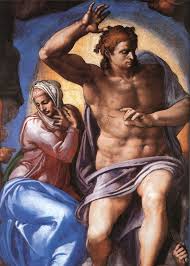 |
Christ and Mary
(torso looks a lot like the Belvedere torso) |
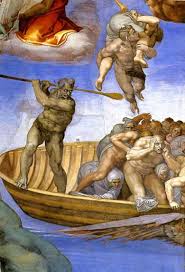 |
| Charon - see his Spock-like ears? |
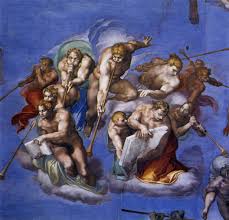 |
| Angels blowing trumpets |
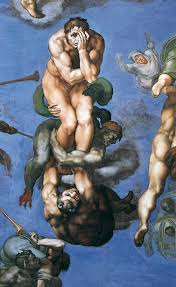 |
One of the damned
Our audio guide said the demons were dragging him down to hell,
condemned to an eternity of constipation. |
Michelangelo loved painting nude figures but at this time in history it was becoming politically incorrect and Church authorities started to complain. So Michelangelo struck back by including his chief critic in the scene like this:
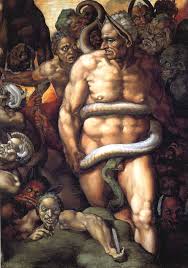
Hmmm . . . I think he had some issues to work out in that relationship. Michelangelo had issues with himself as well. Look how he portrayed himself in this painting.
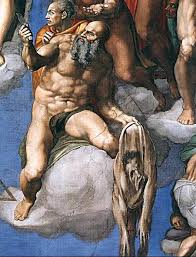 |
| He's the flayed skin - ew! |
By the time we made it through the Sistine Chapel it was very late and a certain member of our party was ready to head back to the hotel. We quickly passed through some rooms displaying modern art, and down a very impressive spiral staircase and finally found our way outside.
 |
| Taran is standing in the middle of the picture. |
 |
| It started as a ramp and gradually turned into stairs. |
 |
| Outside the museum |
After a quick stop for some Italian gelato, we headed back to the subway and from there caught the bus. As you might recall, we didn't know what our bus stop was so we just had to guess. We got off a little earlier than we needed to but found our way back to the hotel nonetheless.
Now, I know it doesn't look like I put less history into my blog - but just imagine how long it would be if I hadn't held myself back. = ) More tomorrow.


Shelley, you are so amazing with all the information you include. How do you remember so much? It's great.
ReplyDelete