The pictures above was taken just outside the entrance to the catacombs. Unfortunately, taking pictures was not allowed in the catacombs - grrr! We had a great guide that showed us around the place and gave us lots of great information about the catacombs . . . much of which I have already forgotten. = ( He was a Filipino friar and we happened to have a family from the Philippines on the tour with us so he gave a little more of an explanation of what he was showing us than he usually did on tours. I got the impression that he was normally pretty wordy - he alluded to the fact that the other tour guides thought he took too long. We didn't mind - he was very entertaining.
The first room he took us in he explained was the original first floor but was now the second floor. The catacombs have 5 different levels with 19 km of tunnels. The reach down 20 meters. The floor we were on was the first to be dug out but then the builders expanded upward and downward. These catacombs were built around 150 AD. Burial inside Rome was forbidden and since the Christians were generally of the lower class most could not afford to buy land for burial. So these catacombs were constructed. The catacombs were carved through volcanic rock which is soft when first exposed to air and then hardens. This allowed them to easily dig their tunnels that would then become stronger when exposed.
 |
| San Callisto Catacombs |
Then small chambers were dug in the tunnel walls for the body. The chambers were custom made - if it was a short body, the chamber was short. We saw many very short ones that we were told were for children. Our guide said that 40% of the bodies in that catacomb were children. The body was bound in linen, placed in the chamber, and then the chamber was sealed up. A slab was place over the seal with the name, age, and date of death.
There were 50 martyrs and 16 popes buried in here. One of the martyrs was St. Cecelia, the patron saint of music. She was 13 when she was martyred and the story goes that they tried to behead her three times, but she still lived. Roman law said that you could only strike three times so they had to stop. She died three days later and was buried here. When the barbarian army was approaching Rome, the pope ordered the body to be removed (the barbarians knew that some treasures were buried with the dead and would break into the burial chambers in the catacombs, dump the body/bones on the floor, and take what they wanted). When Cecelia's tomb was opened her body showed no signs of decay and it was lying in the position of the statue pictured below.
 |
| Statue of St. Cecelia in catacombs |
At first, they were only used for burial, but later chapels were built inside. Until 312 AD, being a Christian was illegal. So Christians would meet for worship in the catacombs. In one of the little chapels, during a worship service, the pope and a few others were surprised by some Roman soldiers and martyred on the spot. They were then buried in the same room.
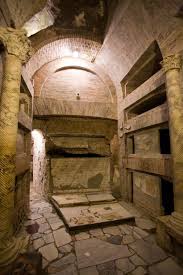 |
| Chapel in San Callisto |
But did people ever live in the catacombs? They may have in some of the other catacombs but not in San Callisto. Those particular catacombs are uninhabitable because the tunnels are full of a weak toxic gas (and he didn't tell us about this until near the end of the tour). It was harmless in small quantities but could make you sick if you were down there too long.
You'll notice that the chambers are no longer sealed. Remember those barbarians? The church has cleaned up all the bones the invaders threw on the floor. Originally they placed them back in the chambers - though it was impossible to sort out whose bones were whose. But soon they found that the bones were disappearing. Apparently pilgrims and tourists were helping themselves to souvenirs! So they took the rest of them away for safe keeping.
Along the walls were frescoes and carvings made by those early Christians.
 |
| The Good Shepherd |
 |
The monogram of Christ - Greek letters x and p
First two letters of Christo in Greek
It marked the grave as that of a Christian |
 |
This is of the disciples - but there is only seven of them.
Our guide promised tell us why at the end of the tour - but he forgot! |
There were also many carvings of doves (representing Christian peace) and fish. The letters of the Greek word for fish,
ichtus, form an acrostic:
Iesùs Christòs Theòu Uiòs Sotèr = Jesus Christ, Son of God, Saviour. Pretty cool, right? And if you wanted to find out if someone was a Christian back in the days that being one could get you killed, you'd discreetly draw half a fish on the ground in the dirt. If the other guy was a Christian, he'd finish the fish. If not, you just discreetly wipe it out. An anchor was another symbol of early Christians. It stood for hope because in ancient times an anchor symbolized safety.
The catacombs fell out of use after Christainity became legal. Christians were then buried in church cemeteries. (Although for a while some still used the catacombs so they could be buried near their relatives that had died earlier.) The relics that had been stored there were moved to above ground basilicas and don't forget those barbarians ransacking the place. They were abandoned and forgotten for hundreds of years. The San Callisto catacombs weren't discovered until 1954.
After our visit to the catacombs we took a short walk on the Appian Way. Thousands of years ago Roman soldiers marched down that very road! Mind blowing!
 |
| Appian Way |
 |
| Cool door on the Appian Way |
 |
| Strolling down the Appian Way |
Then it was time to leave Rome. That was easier said than done. But I got a few more pictures as we drove around trying to understand where Gertrude wanted us to go.
 |
| Another obelisk |
 |
| Aqueducts! Gotta love them! |
We finally made it out of Rome and back into the Italian countryside.
 |
| Hay! |
 |
| Another Italian castle |
 |
| This looks like the new bridge in Dallas! |
 |
| Getting close to Switzerland |
 |
| A church, I think |
Then we hit Switzerland again - I love taking pictures of Switzerland!
 |
| Vineyard on the side of a mountain! |
We were going along fine when suddenly we hit traffic going nowhere. I don't mean just slowly creeping along, I mean stopped - with people standing outside their cars talking. We managed to get off the highway before we were stuck but then what where we to do? We didn't have a map and Gertrude was insisting that we get back on the highway. So Andrew decided to just start driving in the general direction that the highway was going and hope that Gertrude eventually took the hint and found an alternate route. It turned into a very long Indian shortcut taking us along narrow little roads and up and down mountains. Taran got to see more snow and I got some amazing pictures - though, in real life it was even more gorgeous.
 |
| Swiss waterfall |
 |
| Snow - in July! |
 |
| Taran's on top of the world! |
 |
I shot straight out the window at these clouds -
we were so high I didn't have to angle the camera up! |
 |
| Little mountain hostel |
 |
| Those stones on the side of the road were the only barrier to keep you from falling off the mountain. |
I know it's a lot of pictures but that is only a fraction of the ones I took. I filled up my camera's memory card on this trip to Rome - that's 800 picture! I only included the best/most interesting ones in my blog. = )
Well, Gertrude finally found us another way home but I'm not sure that it was faster. Much more interesting, though. We got back to Bruchsal a little after midnight and collapsed into bed.


Wow, that is a lot of information from the Rome trip! You are an amazing tour guide! Thanks
ReplyDeleteThank you so much for doing this blog, I love following you through Europe. The pictures are so beautiful. I love when you take pictures of Switzerland too!
ReplyDeleteLove you,
Cara
SO cool that you keep getting to go back into Switzerland. Love the Pictures!
ReplyDelete